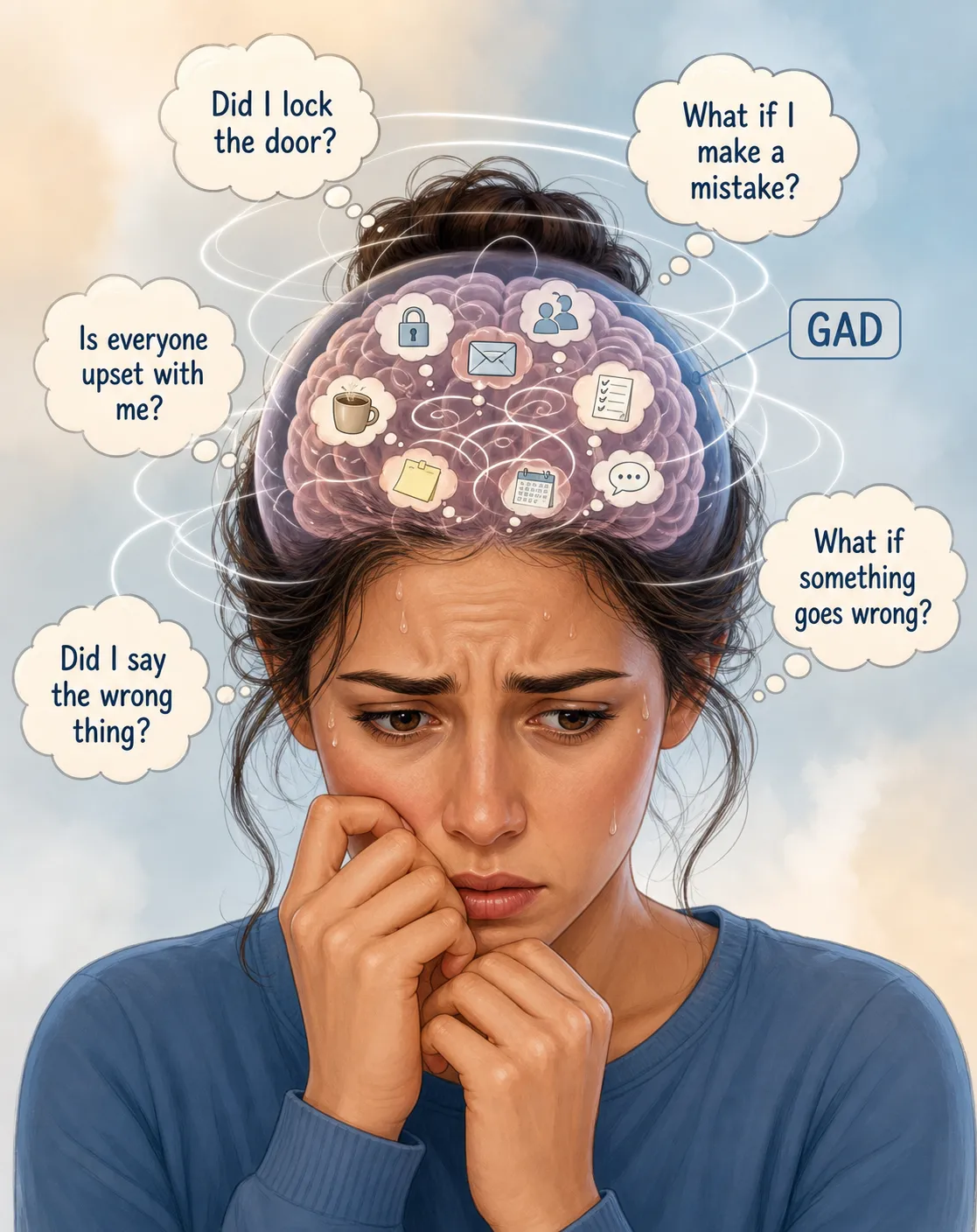
Generalized Anxiety Disorder (GAD)
A 24-year-old mechanic was referred to the medical clinic by a physician. He complained of difficulty sleeping and also experienced frequent dizziness. During the initial interview, he appeared extremely anxious. While talking, he would often become short of breath and sweat excessively. He repeatedly drank water, yet still did not feel that his thirst was satisfied.
His symptoms of intense anxiety were quite severe. He reported that he remained under constant stress and felt worried about almost everything. Whenever he worked with other people or interacted socially, he would become frightened, worrying that something terrible—such as a heart attack or even death—might happen to him. He also spoke about difficulties in his interpersonal relationships, stating that these relationships had become strained. According to him, because of these problematic relationships, he had lost several jobs.
This case illustrates a person with symptoms commonly associated with Generalized Anxiety Disorder (GAD):
- Persistent and excessive anxiety
- Difficulty sleeping (insomnia)
- Dizziness
- Excessive sweating
- Shortness of breath during conversations
- Repeatedly drinking water because of anxiety
- Constant tension and worry
- Fear that something catastrophic (such as a heart attack or death) might occur
- Difficulties in interpersonal relationships
- Occupational impairment, including losing multiple jobs
What is GAD?
Generalized Anxiety Disorder (GAD) is a condition in which a person experiences persistent (chronic), excessive, and uncontrollable anxiety. It is also known as Free-Floating Anxiety because the worry is not always linked to one specific situation.
In GAD
The client experiences persistent tension, worry, and a vague feeling of uneasiness (diffused uneasiness) most of the time.
According to DSM-IV
Everyone experiences anxiety at some point in life. However, when anxiety becomes excessive, persistent, and interferes with daily functioning, it may be diagnosed as Generalized Anxiety Disorder (GAD).
Emotionally
The client often feels:
- Constant nervousness
- Restlessness (feeling jittery)
- Persistent worry about future events
- Fear of having a heart attack
- Fear of losing control
- Continuous worry about negative events that might happen
Cognitively
The client:
- Keeps worrying about small issues repeatedly.
- Finds it difficult to stop worrying.
- Often feels that something bad is about to happen.
- Has difficulty concentrating because the mind remains occupied with worries.
Physically
Common physical symptoms include:
- Excessive sweating
- Rapid heartbeat
- Stomach disturbances
- Headache
- Muscle tension and body aches
- Fatigue
- Difficulty concentrating
- Irritability
- Sleep disturbances
Behaviourally
The client may:
- Become easily startled.
- Avoid situations that increase anxiety.
- Experience difficulty making decisions.
- Keep changing decisions repeatedly.
- Spend a lot of time worrying instead of taking action.
Generalized Anxiety Disorder is characterized by persistent, excessive, and difficult-to-control worry accompanied by emotional, cognitive, physical, and behavioural symptoms that significantly affect a person’s daily life.
“Not every worry is normal, if worry controls your life more than you control your worries, it’s time to pay attention.”
“Prevention is always better than treatment.” The moment we begin to notice changes in our thoughts, emotions, or behaviour, we should not ignore them. When a person experiences constant worry, persistent tension, overthinking, or stress about the future, the body and mind remain under continuous pressure.
In conditions such as Generalized Anxiety Disorder (GAD), the brain begins to perceive almost every situation as a potential threat or danger, even when no real danger exists. As a result:
- The mind stays in a constant state of alertness.
- The body remains under stress.
- Small problems begin to feel much bigger than they actually are.
Comments (0)
Leave a Comment
Your email address will not be published. Required fields are marked *